

=
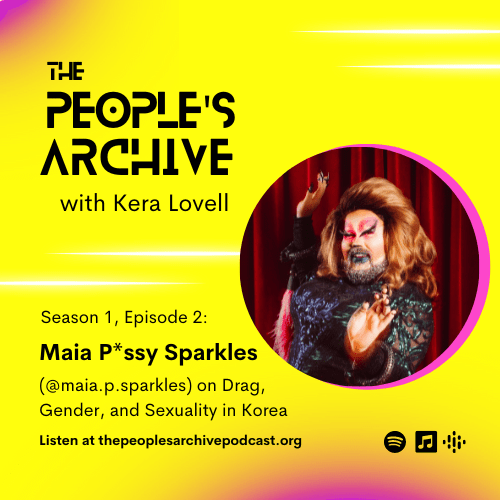
Episode: Maia P*ssy Sparkles
Series: The People’s Archive
Release Date: April 20, 2023
Host: Kera Lovell, from The People’s Archive Podcast
Episode Link:
Tags:
Queer, LGBT, Gay, Trans, Korea, Gay Bars, Queer Dating, Sex, Queer Sex, Queer Community, Seoul, Itaewon, Gender, Sexuality, Korea, Transnational, Drag, Drag Queen, Drag Performer, Fat, Body Shape, Self Love, Beard, Hair, Chosen Family
Description:
Oral History Interview: A conversation with Korea-based drag performer Maia Pussy Sparkles about coming out, building queer community in Korea, drag performances, and transnational queer spaces in Korea, as well well as homophobic religion.
Notes: Kera Lovell: This is a great podcast episode if you’re interested in a transnational exploration of queerness, the change in place from the US to Korea shapes Maia’s queer experience. Maia is quick to note how queer Koreans experience aspects of queer life differently then them due to their outsider foreigner status. It might also be helpful to provide your students with a list of terms and definitions that Maia uses regularly without explanation, including cisgender and trans. The interview was filmed with a Korean student who asks tangential questions about gender and sexuality, and does more to reflect broader sentiment in Korea about fears about one’s queerness rather than curiosity about gender/sexuality as there is so little public discussion of these topics in Korea. Alternatively, these student-question moments can be skipped entirely without missing any of Maia’s own story. While listening to the interview, definitely check out Maia’s IG page: @maia.p.sparkles Clips from this interview posted at The People’s Archive Podcast’s IG page have been included here, and can be a good way to direct students’ attentions to key moments after they listen to the episode in its entirety.

Archival Conversations:
Check out some of the ways in which we have paired moments from this oral history interview with other digital archives:

- Transformations of drag: “View Point: Drag Queen vs Transvestite,” Drag Queens (Magazine), vol 1, no. 1 (1971), pg. 11-12 – On these pages the authors attempt to differentiate between drag queens and what we now define as transgender. Later on pages 22 and 23, the magazine showcases leading drag performers of the era. What do you think were the attributes of a “good” drag queen in 1971 according to the magazine? How does this definition of a drag queen in 1971 differ from how Maia Pussy Sparkles defines drag and gender in 2022 in the interview? https://archive.org/details/drag11unse/page/10/mode/2up Use specifics from the interview and the magazine as evidence to support your argument.

- The emotions behind coming out or letting in: Come Out! released its first issue in November of 1969, titled to encourage people to “come out of the closets and into the streets” – a chant for gay liberation and power. This idea that a queer people should publicly identify on the LGBTQ spectrum was considered radical in 1969 and remains radical in places like South Korea or even in religious communities in the southern/midwestern United States where Maia/Nick is originally from. How does Maia describe their own coming out? Now read through pages 1 and 11 of Come Out! vol 1, no. 1. In what ways was their coming out similar to and different from the stories of coming out in this issue? Compare and contrast the emotions around coming out from both Maia and in the newspaper. Use specifics from the interview and the newspaper as evidence to support your argument. Coming Out! vol. 1, no. 1 (November 1969): pgs. 1 & 11 (available through JSTOR’s Independent Voices/Reveal Digital Archive) https://www.jstor.org/stable/community.28035043

- Comparing drag bar advertisements, 1965 to today: For many queer people, bars are critical to community building. While in the 1960s there were hundreds of gay bars across the US, there are now far less. Here is a program for a drag ball at a gay bar called the 82 Club in New York City. The 82 Club Program (Pamphlet), Queer Music Heritage (ca. 1965). https://queermusicheritage.com/fem-cl82b.html Why do you think the club emphasized that all the performers were male as shown above? Now skim the Instagram page (a type of digital archive) for the queer bar Rabbithole located in Haebangchon, Seoul. https://www.instagram.com/rabbithole_hbc/. Describe 5 ways that you can see differences between the 1965 program and the IG page. How are drag performers described differently? How do the bars describe the atmosphere differently? Do they still emphasize the sex of the performers? If not, what do they emphasize? How are the performers photographed or presented differently? Use specifics as evidence to support your argument.

- Representations of sex and nudity: In the interview, Maia stated that despite having watched gay porn, performing oral sex was the pivotal moment for them in their queer journey. Queer sex has been an important topic for discussion and representation for queer artists. Keith Haring, a 1980s-era pop artist, often depicted erotic elements of the queer experience in his artwork: https://www.haring.com/!/genre/painting. Similarly, the zine series Anonymous Boy (ca. 1990s, linked from QZAP Zine Archive) depicts various scenes and styles of queer sex. https://archive.qzap.org/index.php/Detail/Entity/Show/entity_id/54.
- [Side note: In addition, you can peruse the artwork of another People’s Archive interviewee Sangmin Tang Lee on their website within their “explicit” collection: https://www.tangartproject.com/drawing.]
- Put these sex-themed works in conversation with Maia’s interview. Why might sex be an important theme for queer people like Maia and queer artists like Tang, Haring, and Anonymous Boy? Use specifics from the interview and art pieces/zines as evidence to support your argument.
Topics list:
Looking to design your own assignments? Here is a list of topics with estimated timings covered in this oral history interview:
- CHILDHOOD – 2:00 – child behavior, religion, parents, shaming, family
- 13:00 – Christianity and biological family, chosen family/queer community
- 17:00 – workplace discrimination due to homophobia
- 18:30 – queer genealogies, houses and drag balls, intersectionality
- 21:00 – drag, body hair
- 26:00 – body shaming, hair, body type, fashion
- 40:00 – queer dating, transnational context, Covid outbreak at gay bars in Korea
- 46:00 – coming out
- 52:00 – pronouns
Discussion-Based Clips:
REPRESENTATIONS: In this clip, Maia discusses how they didn’t know that drag queens could be hairy due to the normalization of clean-shaven high femme drag queens. Much of our knowledge about drag performers has been lost due to raids, secrecy, and lack of value in a homophobic culture, yet we do have evidence of bearded drag performers from decades prior, nor do we often discuss the historic links between drag performers and political activism. Activist, museum worker, and drag royalty José Sarria drew crowds to The Black Cat in San Francisco throughout the 1960s. Sarria even ran for office as an openly gay elected official in the Bay Area years before Harvey Milk made headlines doing so in the 1970s. Listen to this 1962 recording of José Sarria while performing life in drag at The Black Cat: https://archive.org/details/jose-sarria-at-the-black-cat (from the GLBT Historical Society via Archive.org). What are key aspects of Sarria’s performance style that you can tell from the audio recording. How do these aspects compare and contrast to representations of drag performances today?
QUEER CHOSEN FAMILY: The concept of “family” is mentioned in nearly every queer newspaper in JSTOR’s Independent Voices/Reveal Digital Archive. Families are mentioned in numerous capacities – as being someone that a police officer attempting to arrest/bribe you might call, as having no impact being gay despite accusations that certain families “caused” homosexuality, and even queer family lifestyles maintaining secret identities. One’s chosen family after coming out can be just as or more important than one’s biological family due to the fact that many queer teens flee abusive families or are outcast from them. How does Maia describe their queer chosen family? Use specifics from the interview as evidence to support your argument?
DEMANDING RESPECT: In the interview, Maia states that while they are flexible on their pronouns and gender identity outside of drag, that when performing as Maia they require she/her pronouns. Respect for the performers (including touching performers only when invited, tipping performers, and calling them by their stage name and stage gender) are *critical* elements to behavior within drag spaces. Watch this clip from the documentary “Remembering The Glade” on drag performances in Hawai’i. Why do you think this aspect of respect is so important for drag performers? What does this indicate about the broader experience for trans and queer people in mainstream society?
Other Relevant Sources:
Article: Heike Bauer, Melina Pappademos, Katie Sutton, Jennifer Tucker; Visual Histories of Sex: Collecting, Curating, Archiving. Radical History Review 1 January 2022; 2022 (142): 1–18. doi: https://doi-org.ezproxy.lib.utah.edu/10.1215/01636545-9397002
Book: Stone, Amy L., Cantrell, Jaime, and Beins, Agatha. Out of the Closet, into the Archives : Researching Sexual Histories. (SUNY, 2015).
Chapter: Kumbier, Alana, “Archiving Drag King Communities from the Ground Up,” chapter in Ephemeral Material : Queering the Archive (2014): pp. 121-154.
Book: Mark Edward, Edward, et al. Drag Histories, Herstories and Hairstories: Drag in a Changing Scene. Vol. 2. Bloomsbury Methuen Drama, 2021.
Book: Barton, Bernadette. Pray the Gay Away: The Extraordinary Lives of Bible Belt Gays. 1st ed. New York: NYU Press, 2012.
Article: moore, madison. “DARK ROOM. Sleaze and the Queer Archive.” Contemporary theatre review 31.1–2 (2021): 191–196. https://doi-org.ezproxy.lib.utah.edu/10.1080/10486801.2021.1878510
Archive: The GLBT Historical Society has a specific primary source set on drag performers accessible digitally: https://www.glbthistory.org/primary-source-set-drag
Archive: The Digital Transgender Archive has more than 1000 items related to the history of drag available online, many that are photographs of historic drag performances: https://www.digitaltransgenderarchive.net/catalog?f%5Bdta_all_subject_ssim%5D%5B%5D=Drag+queens
 Teaching with Podcasts
Leave a comment